

The Joburg Market is the largest fresh produce market in Africa and it is completely owned by the city of Johannesburg municipality(Joburg Market). It is one of the city’s entities that are not collapsing and are able to compete and trade on an international level which is a great success for a state owned entity. Its history goes back into 19th century and it has since grown with the expansion of the city (demand for more produce) and this has to its relocations until its present home in the city deep as it needed more space for the large volumes that were produced.
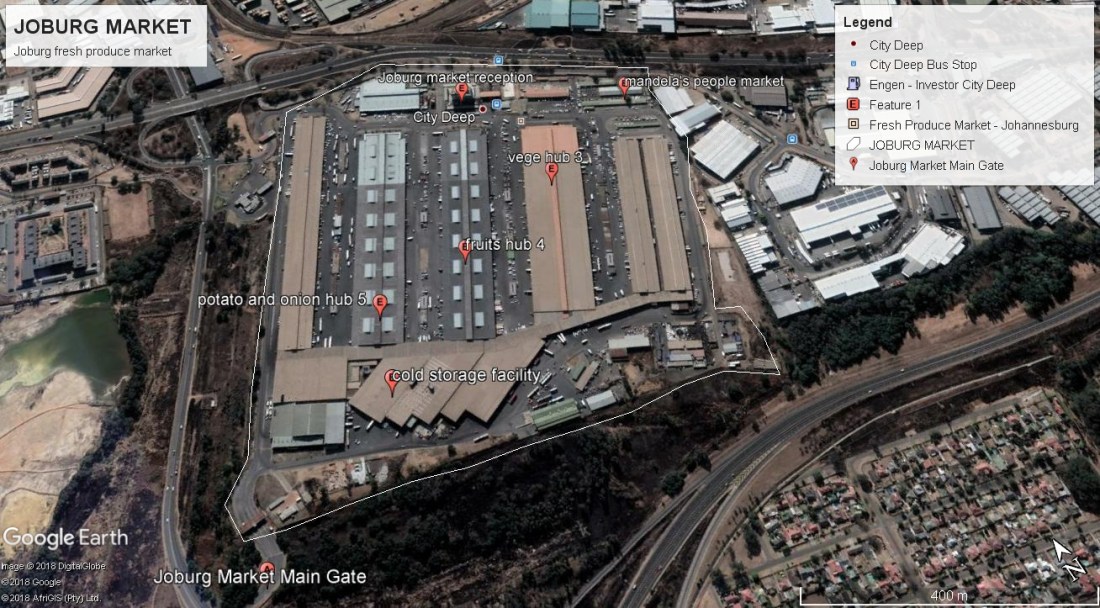
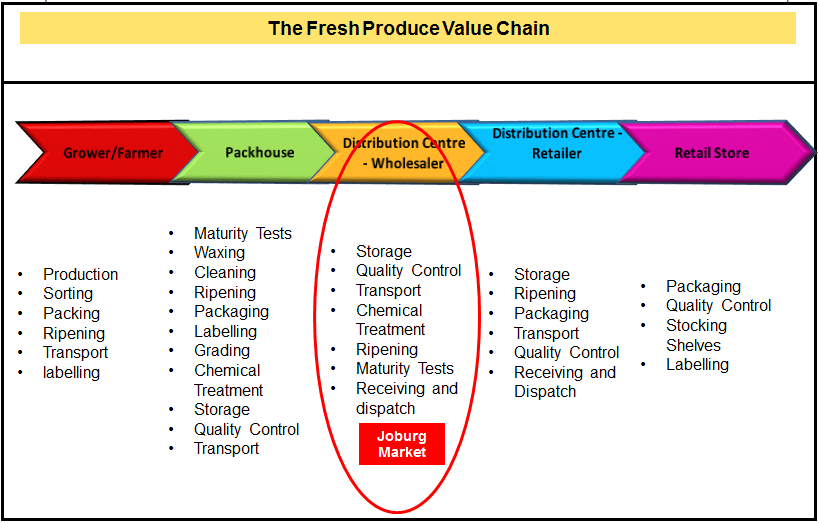
The Joburg market provides a safe space and opportunity for the south african farmers to bring their produce to the markets and it does this through the use of key agencies which their sole purpose is to sell the produce on behalf of the farmers. There are currently more than 5000 farmers that are working with the joburg markets and come as far Limpopo and as local as from urban farmers.
The farmers get to view the key agencies’ profiles and choose the one that suits their produce (this gives the farmer the freedom to decide what happens to his/her produce) and this allows the farmers to focus on production and not have to worry about the marketing of the produce. The key agencies sell the produce to supermarkets, retailers, restaurants, informal traders and even individual persons and this is done at the price that is set by the farmers (not that of the supermarkets).
The opening of the markets to the different stakeholders in itself can be viewed as a food security address. we already have the nutritious food component of food security through the farmers, the market safety policy is that the produce must be handled and treated under hygienic, safe and traceable conditions throughout the supply chain and the agencies tries to bridge the accessibility through distribution component. The economic accessibility is deeply rooted in the farmer setting the price instead of corporate and also the establishment of the mandela’s people market that allows people without forms of identification to become part of the system.


The success of this market has gone beyond the borders of the country as it extend its services to consumers from neighbouring countries. It perhaps most importantly act as a site of study and motivation for governments and food markets within and across the continent of Africa when it comes to its size, value, survival and operation.
The limitation of this market that separates it from the food justice movement is its inability of ensuring safety and justice from the production stage until the consumption stage. The system speaks of fair trade but how much of it is fair if the farm workers of the farm from which this healthy produce we enjoy are being exploited and are paid low wages? It is in this regard that the creation of such markets, good as they are but will not on their own be able to address food security and definitely not food justice as it still alienate the most vulnerable component (immigrant labour) of the food system.
![20181011_144329[1]](https://foodcontemporary.food.blog/wp-content/uploads/2018/10/20181011_1443291-e1539959493708.jpg?w=172&h=300)
![20181011_144936[1]](https://i0.wp.com/foodcontemporary.food.blog/wp-content/uploads/2018/10/20181011_1449361.jpg?w=362&h=362&crop=1&ssl=1 "20181011_144936[1]")
![20181011_144748[1]](https://i0.wp.com/foodcontemporary.food.blog/wp-content/uploads/2018/10/20181011_1447481.jpg?w=362&h=362&crop=1&ssl=1 "20181011_144748[1]")
![20181011_144225[1]](https://i0.wp.com/foodcontemporary.food.blog/wp-content/uploads/2018/10/20181011_1442251.jpg?w=362&h=362&crop=1&ssl=1 "20181011_144225[1]")
![20181011_144451[1]](https://i0.wp.com/foodcontemporary.food.blog/wp-content/uploads/2018/10/20181011_1444511.jpg?w=362&h=362&crop=1&ssl=1 "20181011_144451[1]")
![20181011_143949[1]](https://i0.wp.com/foodcontemporary.food.blog/wp-content/uploads/2018/10/20181011_1439491.jpg?w=362&h=362&crop=1&ssl=1 "20181011_143949[1]")
![20181011_143937[1]](https://i0.wp.com/foodcontemporary.food.blog/wp-content/uploads/2018/10/20181011_1439371.jpg?w=362&h=362&crop=1&ssl=1 "20181011_143937[1]")

![20180926_133336[1]](https://foodcontemporary.food.blog/wp-content/uploads/2018/09/20180926_1333361.jpg?w=1100)
![20180926_133157[1]](https://foodcontemporary.food.blog/wp-content/uploads/2018/09/20180926_1331571.jpg?w=1100)
![20180926_133328[1]](https://i0.wp.com/foodcontemporary.food.blog/wp-content/uploads/2018/09/20180926_1333281.jpg?w=470&h=264&ssl=1 "20180926_133328[1]")
![20180926_133309[1]](https://i0.wp.com/foodcontemporary.food.blog/wp-content/uploads/2018/09/20180926_1333091.jpg?w=470&h=264&ssl=1 "20180926_133309[1]")
![20180926_140222[1]](https://i0.wp.com/foodcontemporary.food.blog/wp-content/uploads/2018/09/20180926_1402221.jpg?w=148&h=264&ssl=1 "20180926_140222[1]")
![20180926_133243[1]](https://i0.wp.com/foodcontemporary.food.blog/wp-content/uploads/2018/09/20180926_1332431.jpg?w=830&h=467&ssl=1 "20180926_133243[1]")
![20180926_140152[1]](https://i0.wp.com/foodcontemporary.food.blog/wp-content/uploads/2018/09/20180926_1401521.jpg?w=262&h=467&ssl=1 "20180926_140152[1]")
![20180926_140113[1]](https://i0.wp.com/foodcontemporary.food.blog/wp-content/uploads/2018/09/20180926_1401131.jpg?w=546&h=546&crop=1&ssl=1 "20180926_140113[1]")
![20180926_140120[1]](https://i0.wp.com/foodcontemporary.food.blog/wp-content/uploads/2018/09/20180926_1401201.jpg?w=546&h=546&crop=1&ssl=1 "20180926_140120[1]")



 FOOD DYNAMICS