
CAMBRIDGE FOOD SUPERMARKET De Villiers Street
ADDRESS: 42 De Villiers St, Johannesburg, 2001

The supermarket carefully picked as a site of study was established in the 1990s with only six stores selling fresh meat in the KwaZulu-Natal province. Today they are a chain of way more than thirty outlets or franchises operating in eight provinces around South Africa. Cambridge Food has spent years building their fresh face business on a foundation of unbeatable value for the savings-focused customers.
The demonstrations seeks to illustrate the demographics of a supermarket in downtown Johannesburg. The careful analysis on the site tries to link the social happenings in this store and try to relate it to other stores elsewhere. It brings forth the socio-economic factors of shopping and also brings the element of the informal sector into play.
The results and observations drawn from the careful analysis of this supermarket has clearly shown how they have kept to their vision and promise made to the public which is to provide the lowest prices for their goods. It has lower prices so as to allow the lower income households to save enough money to pay other bills, thus improve their standard of living. As observed from the above demonstrations, the outlet visited caters mostly for the black population who are in the low income financial category. The prices provided by this supermarket are much more affordable for them as compared to the other supermarkets. The general plan of the shop is quite simple and easy to follow as it flows from the entrance to the exit.
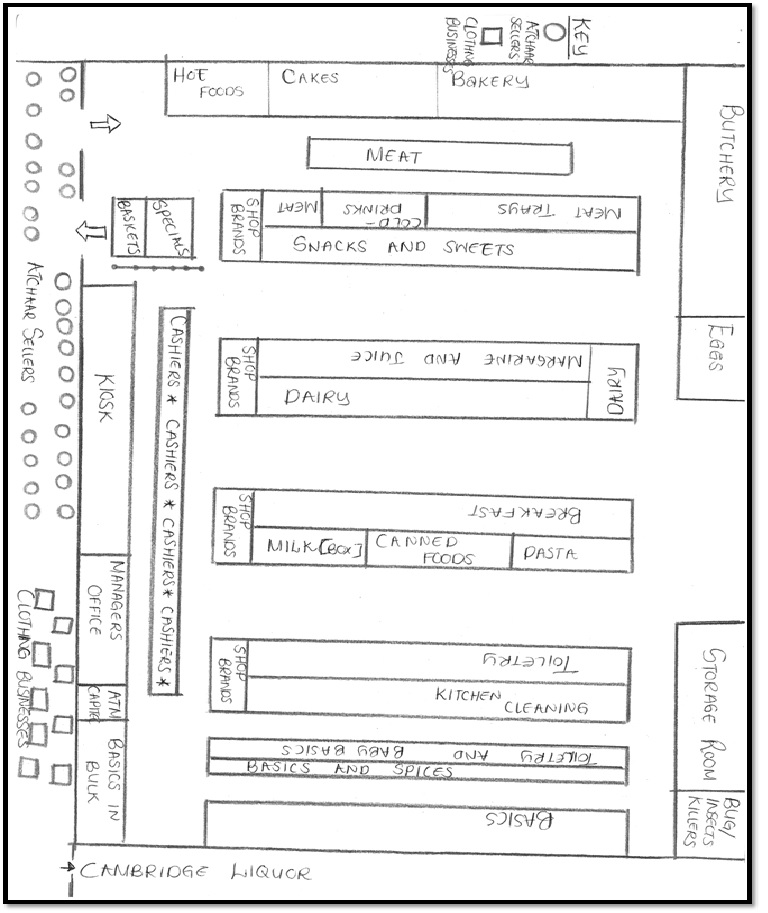
The aisles are represented according to which products are found on the shelves. All the shelve tops in the store are used as storage spaces as there are bulk products which are stored in boxes and plastics so as to keep them to replace the ones on the shelves when they are finished. This form of storage observed clearly insinuates that the storage room present in the store is very small to accomodate all the unopened goods. Unlike the other stores nationwide, the entrance and exit is on the same side and next to each other just divided by the small rail inbetween.
The store sells a range of high-quality national brands, plus goods that they source and pack themselves under their own brand label, across all major categories, as this is seen in the store plan. They promote their own brand goods by placing them on the front of every shelve opposite the tills so that the customers can pick them first. In every aisle, there are strips of snacks and sweets hanging between the shelve dividers as they try and capture the kids attention. These are at the kids eye level. Each and every aisle has its own specific smell depending on what it sells, in the basics and spices isle one can smell the aroma of the spices which will influence the customer to buy the spices. With regards to the breakfast aisle, the order in which the products are packed clearly shows that they have a marketing strategy. From the back, the aisle begins with hot beverage products, then cookies or biscuits, then the cereals. In that manner they make the customer understand that they need the biscuits to go with the hot beverage products, thus they buy both without the initial intention to do so.
 FOOD DYNAMICS